|
|
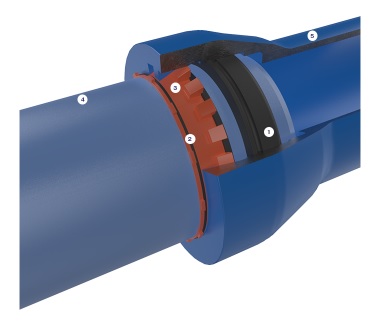
1. Rubber Gasket (EPDM)
2. Wrapping Strip
3. Lock Segments
4. Spigot end
5. Socket end
|
Dimensional range
|
Dn,
mm
|
Lu,
mm
|
Dimensions |
Nominal Thickness |
Weight |
Class |
|
DE
mm
|
DB
mm
|
P1, TJ
mm
|
S
mm
|
C
mm
|
Kg/pc. |
Kg/m. |
| 80 |
5.5 |
98 |
168 |
85 |
4.9 |
4.0 |
65.4 |
11.9 |
C50 |
| 100 |
5.5 |
118 |
189 |
88 |
4.9 |
4.0 |
76.4 |
13.9 |
C50 |
| 125 |
5.5 |
144 |
216 |
90 |
4.9 |
4.0 |
95.8 |
17.4 |
C50 |
| 150 |
5.5 |
170 |
243 |
94 |
4.9 |
4.0 |
115.0 |
20.9 |
C50 |
| 200 |
5.5 |
222 |
296 |
100 |
4.6 |
4.0 |
157.1 |
28.6 |
C40 |
| 200 |
5.5 |
222 |
296 |
100 |
5.4 |
4.0 |
175.1 |
31.8 |
C50 |
| 250 |
5.5 |
274 |
353 |
105 |
5.5 |
4.0 |
221.6 |
40.3 |
C40 |
| 250 |
5.5 |
274 |
353 |
95 |
6.4 |
4.0 |
250.4 |
45.5 |
C50 |
| 300 |
5.5 |
326 |
410 |
110 |
6.5 |
4.0 |
293.3 |
53.3 |
C40 |
| 350 |
5.5 |
378 |
465 |
110 |
6.9 |
5.0 |
374.8 |
68.1 |
C30 |
| 400 |
5.5 |
429 |
517 |
110 |
6.5 |
5.0 |
438.6 |
79.7 |
C30 |
| 450 |
5.5 |
480 |
575 |
120 |
6.9 |
5.0 |
517.5 |
94.1 |
C30 |
| 500 |
5.5 |
532 |
630 |
120 |
7.4 |
5.0 |
614.9 |
111.8 |
C30 |
| 600 |
5.5 |
635 |
739 |
120 |
8.6 |
5.0 |
833.4 |
151.5 |
C30 |
| 700 |
5.5 |
738 |
863 |
150 |
8.8 |
6.0 |
1015.7 |
184.7 |
C25 |
| 800 |
5.5 |
842 |
974 |
165 |
9.6 |
6.0 |
1251.7 |
227.6 |
C25 |
| 900 |
5.5 |
945 |
1082 |
175 |
10.6 |
6.0 |
1533.1 |
278.7 |
C25 |
| 1000 |
5.5 |
1048 |
1191 |
185 |
11.6 |
6.0 |
1841.3 |
334.8 |
C25 |
DN: nominal diameter
Lu: length in mm
Class: pressure class according to EN545 and ISO2531
S: nominal thickness of the ductile iron wall ISO 2531 and EN545, in mm (in case of slight differences the higher value among the two standards is to be considered)
DE: nominal external diameter of the pipe according to EN545 and ISO2531, in mm
P1: depth of insertion in mm
C: nominal thickness of the internal lining in cement mortar blast furnace according to EN 545, in mm
Mass: total mass per pipe and per meter (including internal coating and socket) determined with the nominal thickness, in Kg/m
* Information concerning pipes' dimensions from DN1000 is available upon request
Main technical features:
- Pressure class in accordance with EN 545:2010 and ISO 2531:2009.
- External coating in zinc- aluminum alloy (400 g/m2) applied by metallization and watery epoxy paint certified to be in contact with water intended for human use.
- Internal lining in cement mortar blast furnace sulfate-resistant in accordance with EN 545 and ISO 4179
- Pipes are designed in such a way that individual pipes are connected using the lock system to form one complete system without need of welding, screwing, testing, surface treatment or without having problem of loosening.
Internal linings:
- Cement Mortar Lining - is a dense homogeneous layer covering the entire inner surface of the trunk of the pipe. The mixture of cement mortar contains cement, sand and water. Cement can be of several types depending on the type and chemical composition of the fluid pumped in the pipeline: ordinary portland cement (OPC), sulphate resistant cement (SRC), blast furnace slag cement (BFSC), high alumina cement (HAC). At the same time, the water used in the cement-sand mixture corresponds to the standard set for drinking water. The thickness of the cement-sand coating is for pipes DN40-300 - 4,00 mm, DN350-600 - 5,00 mm, DN700-1200 - 6,00 mm, DN1400-2000 - 9,00 mm, DN2200 - 12,00 mm.;
- Epoxy Seal Coat;
- Bituminous Seal Coat.
Outside coatings:
- Zinc Coating (130 gm/m²² or 400 gm/m²);
- Alloy of Zinc and Aluminum with a minimum mass of 400 gm/m².
Finishing protection layer:
- Blue epoxy (from 70 to 100 micron);
- Redepoxy;
- Black bitumen
Special coating:
- External and Internal Polyurethane Coating (DN 100 - DN 1600)
International standards: ISO2531, ISO7186, BS EN545, BS EN598, ISO:9001, ISO:14001.
Competitive advantages:
- Quick and safe installation thanks to the locking system;
- Fast execution of the installation and possibility of reducing the number of fittings, even in the case of land with irregular elevation course, due to the high angular deviation;
- Excellent behavior in case of earthquake;
- Low roughness that determines minimum pressure losses Resistance to corrosion by corrosive waters;
- Resistance to corrosion by aggressive soils in most of the cases.
IMPORTANT! The technical specialists of our company are always ready to help you make the right choice of Ductile Iron Pipes taking into account the characteristics of the pumped medium, the working pressure in the system, the specifics of the soil for laying pipes and a number of other important factors that will ensure the durability of the pipeline system built using high quality JINDAL pipes.


